
GINNGER
Active2023 – present
Overview
GINNGER is an Horizon Europe Innovation Action that supports the regeneration of European neighbourhoods through co-creation processes that engage heterogeneous stakeholder structures. The project combines social-science innovation with a digital toolkit of 13 digital solutions organised in four blocks: Energy, Renovation, Resources, and Mobility; and validates them across 6 pilot sites in 5 EU member states: Langreo (ES), Plovdiv (BG), Massagno (CH), Murcia (ES), Orte (IT), and Paris (FR).
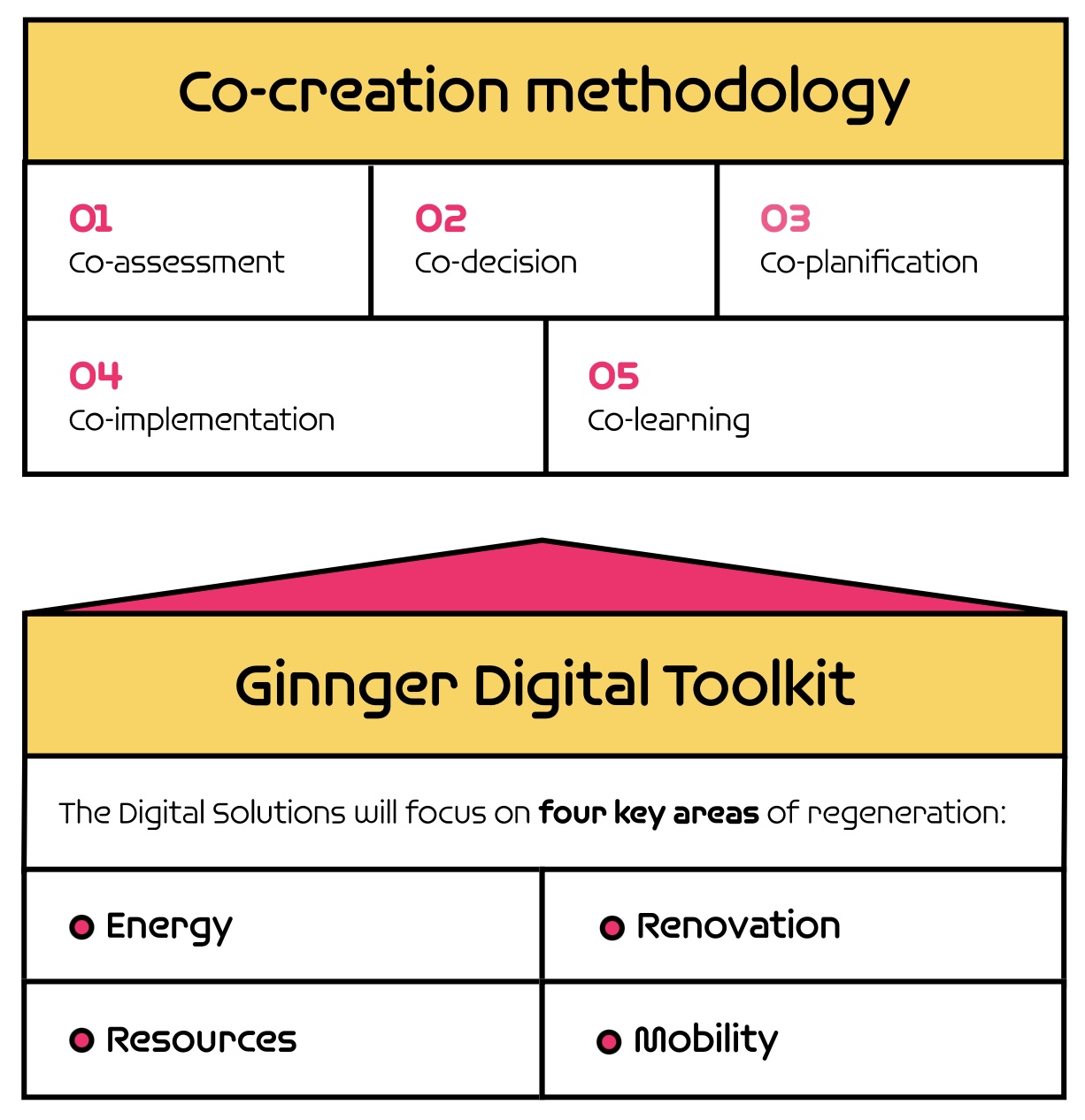
IDeA’s contribution focuses on the Mobility block, and specifically on DS13 — E-mobility Optimal Planning Tool, deployed in the Swiss pilot.
IDeA’s role
IDeA is involved in DS13, which consists of the implementation of an optimal E-Mobility OPEM planning tool using data-driven methods to identify the most opportune locations for the installation of charging stations. The tool takes as input the local mobility patterns, the existing electrical and charging infrastructure, the candidate locations for new stations, and a portfolio of charger technologies, and returns an investment plan that balances coverage of mobility demand against capital costs and grid-level constraints.
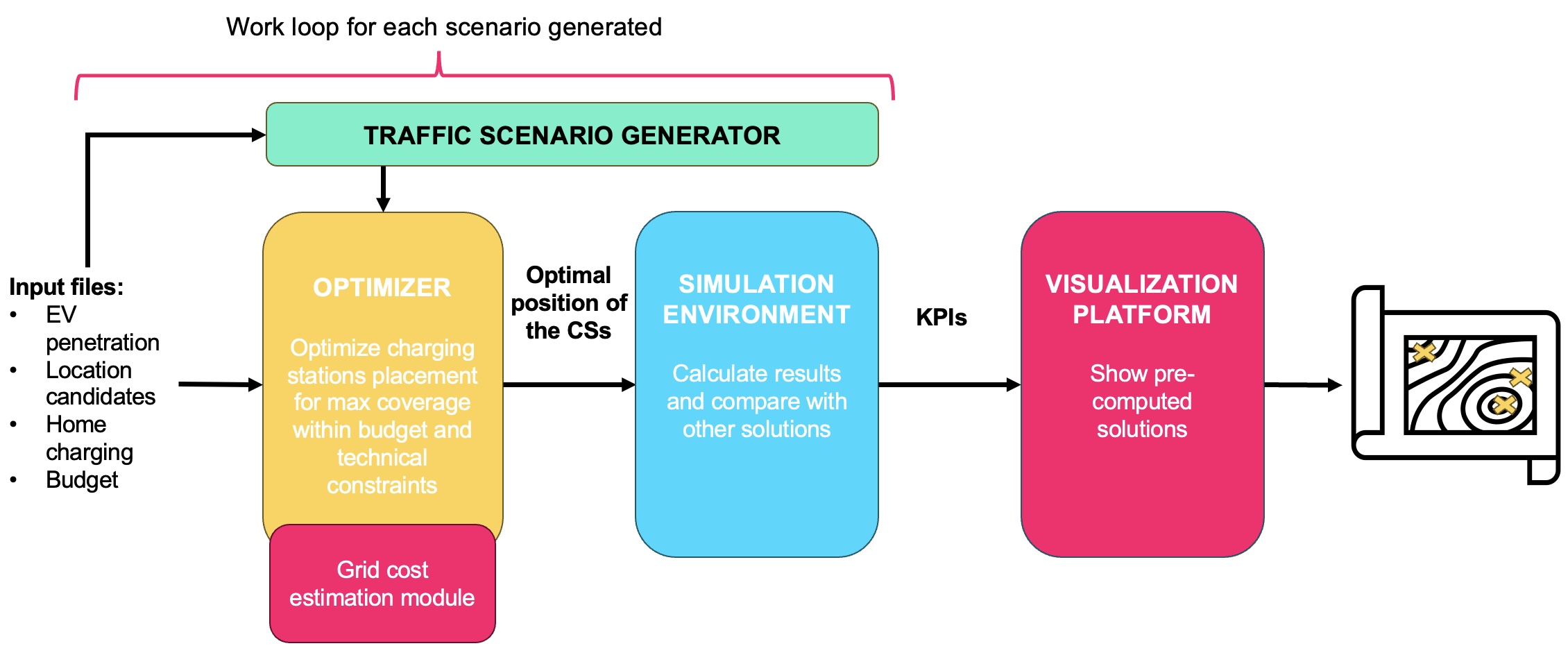
The Swiss pilot covers the district of Massagno, a residential and mixed-use area. The district aims to triple the penetration of public charging stations within the neighbourhood as part of its regeneration strategy.
Optimisation Approach
IDeA developed the optimisation engine for DS13. The problem is formulated as a Mixed-Integer Linear Programme (MILP) that decides:
- which new stations to open among a set of candidate sites.
- how many chargers of each type (e.g. slow, fast) to install at each station, including stations that already host some infrastructure.
The model accounts for several layers of real-world costs and constraints:
- Capacity constraints at each station, both in terms of total installed power and number of charging points, considering chargers already installed at existing sites.
- Time-resolved power and demand balance across the day. At every time interval the chargers installed at a station must be able to serve the energy and the number of EVs arriving from the routes assigned to it.
- Budget constraint that aggregates station opening costs, charger purchase costs, grid participation fees, electrical panel installation, civil engineering interventions.
- Minimum utilisation at every newly opened station, to avoid investing in infrastructure that would remain idle.
The model supports two configurable objectives that reflect different planning priorities:
| Objective | Optimises for |
|---|---|
coverage |
Maximum coverage of mobility flows. |
kwh |
Maximum energy delivered across served flows. |